FlemingClans.com

"Scotland's Fleming Clan: a Genealogical History" - coming in 2027!
Estate: Earldom of Wigtown
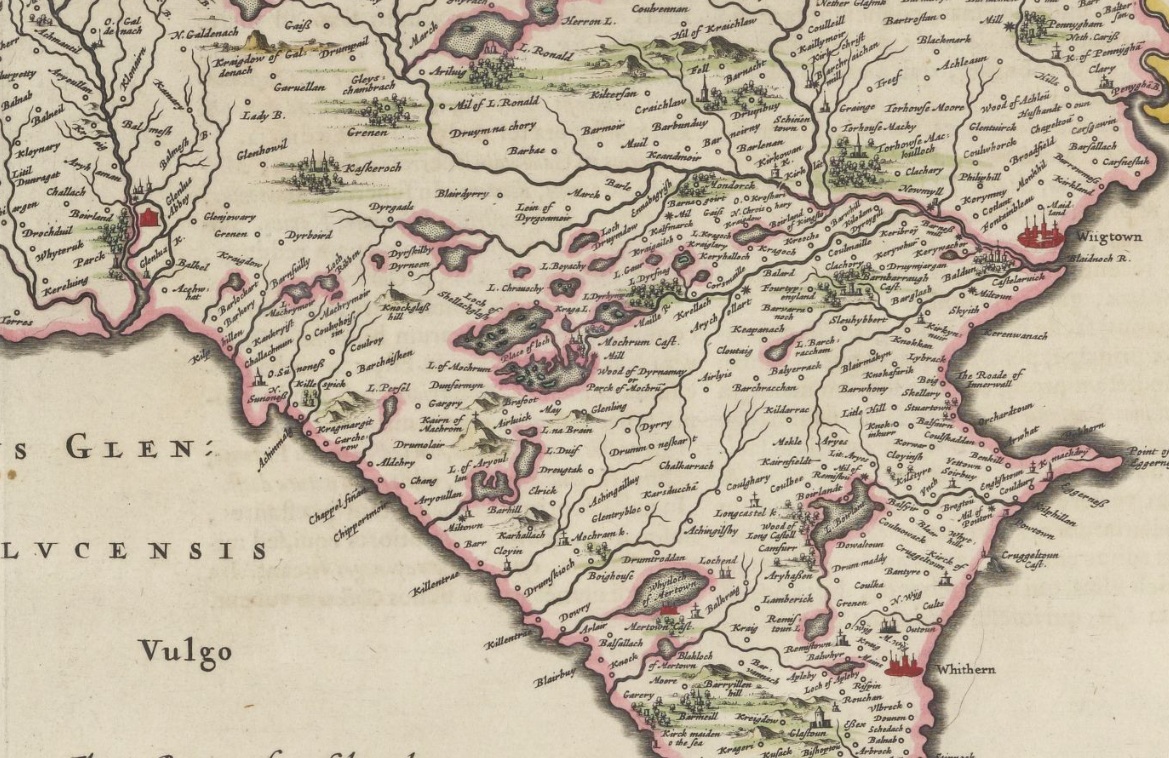 Earldom of Wigtown, Wigtownshire
1341 - 1372
The earldom of Wigtown, in the far south-west of Scotland, was granted by King David II to Malcolm Fleming of Fulwood in 1341 in gratitude for his loyalty. It made Malcolm the first Fleming peer, but his grandson Thomas sold it to Archibald the Grim in 1372. The title was revived for the family in 1606, without the lands.
Acquisition
King Robert I had already confirmed Malcolm Fleming of Fulwood in the lands of Poulton in Wigtownshire around 1327. On 9 November 1341 King David II granted him Farines, the Rhinns and the whole burgh of Wigtown as a free earldom, for the service of five knights, and by a royal charter of 9 November 1342 Malcolm was created Earl of Wigtown. In 1342 he also received the barony of Mochrum, which he soon exchanged for Cardoness.
Estates within the earldom
The earldom included the burgh and lordship of Wigtown, the Rhinns, Mochrum (briefly), Carnesmoel or Kirkinner in the Machars, the Knock of Luce near Glenluce, and Poulton. In December 1357 Malcolm had a confirmation of Carnesmoel and the Knock of Luce and granted the five-merk land of Carnmole and Knoclucbirvan to Glenluce Abbey.
A diminished earldom
Thomas Fleming inherited the earldom from his grandfather. In the 1360s he resigned it to David II and returned a sum of money, and on 26 January 1367 the king confirmed him in it, but without the right of regality. Surrounded by the growing power of Archibald Douglas, Lord of Galloway, the earldom was of little practical value to him.
Disposal
On 8 February 1372 Thomas sold the earldom to Sir Archibald Douglas, “the Grim”, for five hundred pounds. King Robert II confirmed the sale, Thomas resigned the lordship of Wigtown to the king at Perth on 19 April 1372, keeping only the barony of Carnysmule, and Parliament ratified the sale in October.
On 19 March 1606 King James VI created John, 6th Lord Fleming, Earl of Wigtown, Lord Fleming and Cumbernauld. This second earldom was a title only; “the lands of the earldom” now meant the Fleming baronies elsewhere. The title became dormant on the death of Charles, 7th Earl, in 1747.